
Cultural Appropriation in China?
Living in China is the best way to ensure that your life is spent constantly tying yourself up into intellectual knots. My ‘quandary of the week’ this week was about cultural appropriation.
Let me set the scene. Cultural appropriation is a situation where someone from a dominant position in society inappropriately adopts a tradition from someone in a less dominant position. And we all know what this means through a European/American lens, a white person there is clearly trespassing on someone else’s culture if they inappropriately wear afro wigs, Sikh turbans or Native American headdresses, for example. But I can potentially see plenty of grey areas to this too. For example, is it cultural appropriation when someone who speaks with an accent from a more affluent part of a country adopts a regional accent from elsewhere? Or what about when a white person becomes a fan of hip hop - with its specific African American historical context - and then starts wearing clothes associated with that style? I guess the key aspect is in what kind of adoption is deemed ‘appropriate’ and ‘inappropriate’, and we can all see how these definitions can change as society progresses… or regresses.
In China, there’s an academic term for cultural appropriation, it’s 文化挪用 [wénhuà nuóyòng]. This is way above my conversational pay grade, so I have no idea how many people even know this oblique reference. I asked a few Mainlanders, Hongkongers and Taiwanese people in my circle, and even the ones who knew it didn’t really think it applied to China. So although the dominant culture here is the Han, there’s no reckoning that a Chinese Han person wearing clothes from a minority ethnicity could be deemed intrinsically inappropriate or offensive.
It is common practice here for Han Chinese tourists to take photos of themselves in local costumes when they visit areas populated by ethnic minorities. The people I asked told me that they wouldn’t associate this with the concept of cultural appropriation, and that the behaviour of the wearer was based on respectful curiosity, thousands of years of cultural intermingling, and a genuine appreciation of the aesthetic beauty of the garments. When I asked about what the minority ethnicities themselves might think about this, for most people it was the first time they had thought about it in that way. The ones who answered did so confidently, saying that the ethnic minorities aren’t offended. At the very worst, it was a kind of Chinese ‘cosplay’ done out of reverence rather than mockery.
It’s a tricky one to figure out, because China exists outside the specific history of colonialism and slavery that typifies the way we look at cultural appropriation in Europe and the Americas. So it’s inaccurate to do a like-for-like comparison, and I try not to impose my own cultural baggage onto anyone else. What muddies the waters further is that the government in China has made a point of pushing the narrative of 和谐 [‘harmony’] between Han Chinese and the other 55 officially-recognised ethnicities in China, so anything that speaks against this is seen as political sacrilege. So there’s zero chance that I could witness an open debate about this, even if my Mandarin skills were up to it. Which they most definitely aren’t.
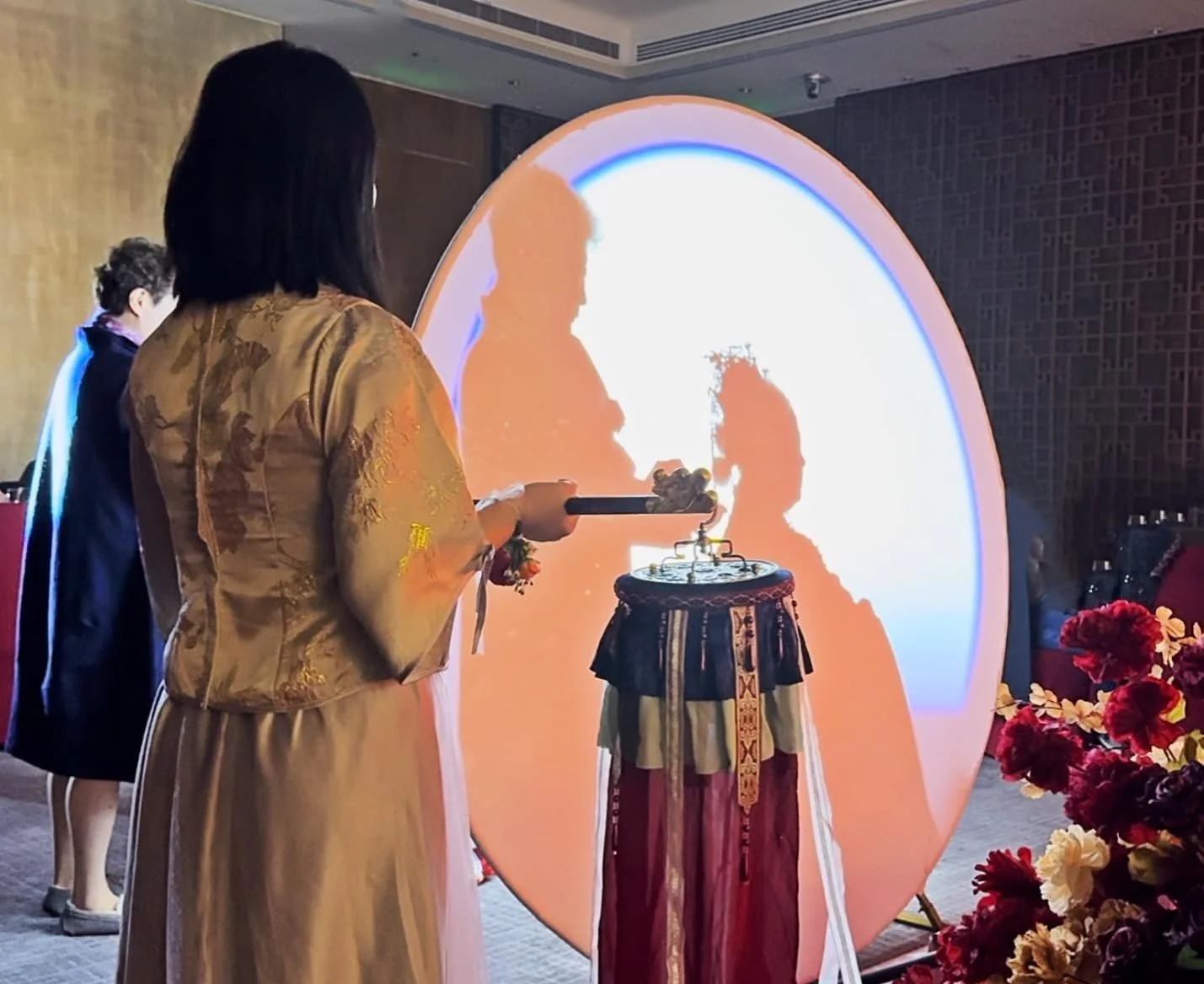
Now we’re getting to my quandary of the week. We had been invited to a traditional Chinese wedding, which in itself is quite rare in Shanghai. Most people these days have modern weddings which would be recognisable to anyone around the world. But this was very different, the bridal party were all dressed in amazing traditional attire and performed a variety of ceremonies that harked back to rites of old. So in a way, the wedding was a sort of traditional Chinese ‘cosplay’, where our fellow Chinese guests were dazzled to a rare experience in just the same way as we were. With this in mind, we had been told that the bride would appreciate if we respected the occasion, and were encouraged to wear formal Chinese attire.
I’ve lived in China for almost a decade, and have made a point of never wearing anything traditionally ‘Chinese’, lest it be misconstrued as a disrespect to my host country. Yet we were convinced that this was clearly a case of ‘appropriateness’, so we bit the bullet and got some Chinese-style suits made. That would have been the end of this anecdote, were it not for what happened on the night of the wedding. Luckily we arrived early, so we were able to see guests as they trickled into the venue. And it soon became clear that there had been a massive miscommunication. None of the other guests were wearing anything approaching traditional Chinese clothing. In fact, many of them appeared to be wearing clothes that they had worn earlier that day. We’re talking jeans, even sweatpants. Meanwhile I was sat there looking like a poor imitation of Sun Yat-Sen.
We solved the issue by quickly removing our jackets, and we were able to blend in with the other guests a little easier. But not before we were noticed by the bride and groom themselves, who both greeted us with straight faces. One day I would like to get them drunk and ask them what they truly thought about our ridiculous appearance. I hope it will become a funny family anecdote that they can tell their kids in the future. But until then I will add this to the countless other embarrassments that seem to have constituted my life up till today.
If there is any moral to this story, let it be this. The definition of cultural appropriation can indeed change over time, perhaps even in China. Sometimes it takes a generation, and sometimes it literally takes FIVE MINUTES OF TESTICLE-SHRINKING TORTURE. So when in doubt, don’t be an arse, and wear your regular clothes.
For the Instagram version, see here.
For the Facebook version, see here.
For the LinkedIn version, see here.